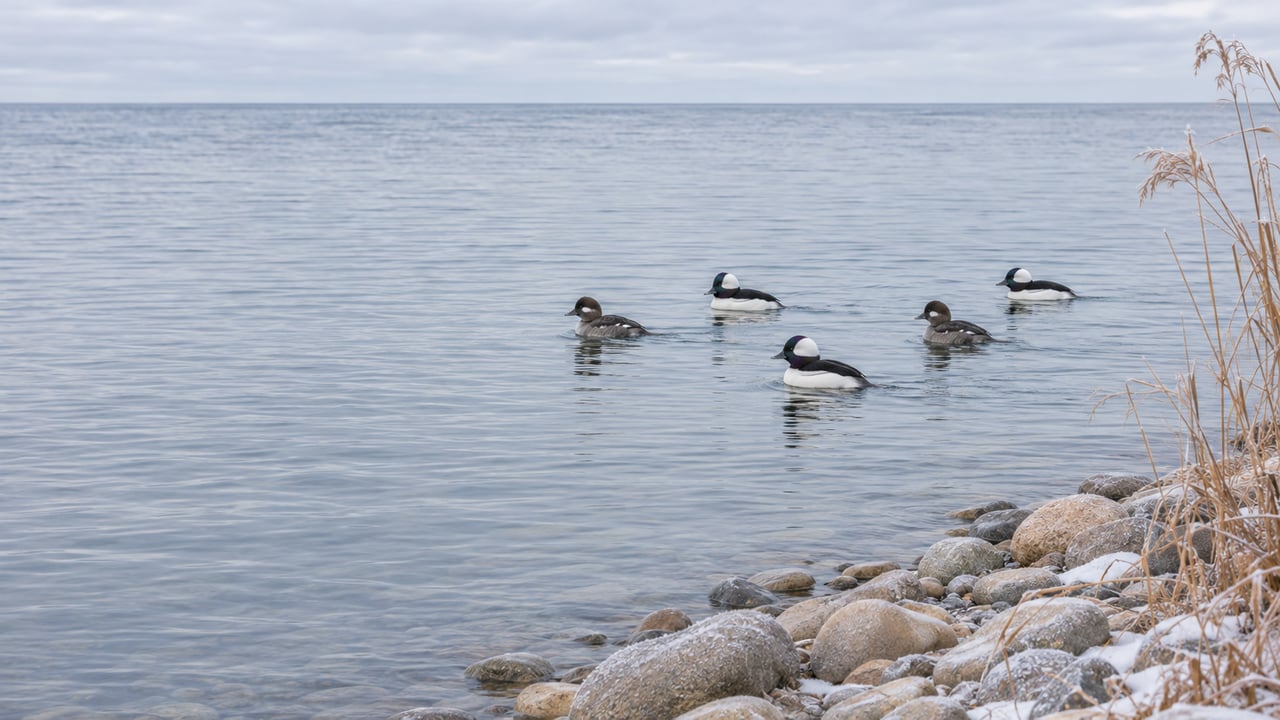
On Saturday, November 14, a birder walked Rattray Marsh Conservation Area for an hour and 21 minutes, starting at 9:11 a.m., and logged the walk on eBird. The checklist recorded 66 Red-breasted Mergansers, 28 Common Goldeneyes, eight Long-tailed Ducks, three Buffleheads and two White-winged Scoters. Also on it were 25 Canada Geese and one Mute Swan. Counting only those five duck species, that's 107 ducks against 25 geese in a single morning in mid-November.
When ducks like these are being reported, it helps to know which parts of the conservation area look out on Lake Ontario and which way in gets you there first.
Where the lake comes into view
Credit Valley Conservation's Rattray Marsh page describes a shale beach and a boardwalk over the wetland. It names two routes, the Knoll Trail boardwalk loop and the Pedestrian Waterfront Trail, which runs through the conservation area. CVC's photo gallery on that page labels three places that face the lake: the "Shingle bar," the "Inlet from Lake Ontario and the marsh," and a "View of Lake Ontario shoreline." Those are the places to stop and lift the binoculars.
The inlet is one of the things that makes the marsh hard to predict. The South Peel Naturalists' Club's birding guide calls Rattray "a place of moods and seasons." It notes that the marsh depends on Sheridan Creek and on an outlet to Lake Ontario that is just as unpredictable, so "one never knows what to expect in the marsh." In CVC's Rattray Marsh FAQ, the marsh is particularly important for migratory birds in spring and fall. During those seasons, ducks, geese, songbirds, birds of prey, herons and shorebirds travel across the lake and along the shoreline and stop at Rattray to rest and feed. The November 14 checklist was logged during that fall window.
Last winter's list was longer than the ducks
eBird's bar chart for the Rattray Marsh hotspot covers December 2025 through February 2026. Over those three months, birders recorded 44 species there. The single November 14 checklist had 18. One morning at the marsh shows you part of the season, and the full winter list builds up over many visits.
Last winter's waterfowl look like this November's birds, with more variety. The chart lists Greater Scaup, White-winged Scoter, Long-tailed Duck, Bufflehead, Common Goldeneye, and both Common and Red-breasted Mergansers. It also has two kinds of swan, Mute and Trumpeter. If you see a big white swan off the shingle bar this winter, it could be either one.
Away from the water, the list moves into the trees. Last winter's chart has Ring-billed, American Herring and Great Black-backed Gulls. It also has Sharp-shinned, Cooper's and Red-tailed Hawks, plus Eastern Screech-Owl and Red-bellied, Downy and Hairy Woodpeckers. The club's guide notes that the woodland trails away from the marsh "yield more than a few surprises." If you go out to the shingle bar and come back by the Knoll Trail loop, you get time at the lake and time in the trees.
The lakeside way in from Jack Darling
The club's guide lists several ways in. One is Green Glade Senior Public School off Meadow Wood Road, another is the foot of Bexhill Road, and the third is Jack Darling Park, a little further east, where you walk west along the Lake Ontario shore. For winter birding, the Jack Darling route has the lake beside you the whole way to the marsh. CVC's parks FAQ names Jack Darling Memorial Park, at 1180 Lakeshore Road West, as the place to park for Rattray Marsh. The City's page for the park lists five parking lots.
Plan on one detour along Lakeshore. Peel Region has a construction compound on the Jack Darling Park boulevard for its Lakeshore sewer and watermain project. The Lakeshore Road West Trail goes around the compound, which Peel expects to keep in place until late 2029. We covered that project in our look at the Lakeshore Road construction stages. A separate upgrade at the Jack Darling Sewage Pumping Station may cause short disruptions in the park and on its trails, the leash-free areas included. Jack Darling has a leash-free zone. Dogs inside the conservation area fall under CVC's own visitor rules.
CVC's visitor rules include one line worth remembering through the cold months: "All boardwalks are slippery when wet." In late November that covers frost, freezing drizzle and the first wet snow. CVC's park advisories page currently lists Rattray Marsh as "Open during operating hours," and it's the page to check before you head out. Last December, insauga listed Rattray Marsh among the conservation areas open for winter hiking and sent readers to those CVC advisories for current conditions.
December 19 brings Clarkson into the 64th count
On one day in December, a walk to the shingle bar can go into a long-running record. The South Peel Naturalists' Club has set its 2026 Christmas Bird Count for Saturday, December 19. It will be the club's 64th count as an official Audubon Christmas Bird Count circle, under the code ONPH. The count circle is 15 miles across, centered in Oakville on Upper Middle Road midway between 8th and 9th Lines.
Clarkson falls in two of the count's six areas, which meet at Clarkson Road. Area 5 runs from Winston Churchill Boulevard east to Clarkson Road. Area 6 runs from Clarkson Road east to the Credit River, and it is led by Mark Cranford, who also coordinates the whole count. Each area leader picks their own meeting place. Field teams usually start at 8 a.m. and finish around dusk, between 4:30 and 5 p.m. The club says in bold that you don't need to be an expert or even an intermediate birder to take part. It asks anyone with a spotting scope to bring it to help count waterfowl along the lakeshore. Those are the same mergansers and goldeneyes that were on the November checklist.
You can also take part without going out on a trail. The club wants counts from backyard bird feeders anywhere in the circle, and you don't have to be a member. For each species, it asks for the highest number seen at your feeder at one time during the day, and it suggests asking a neighbor with a feeder to count on December 19 too. If you're out in the field, the simplest way to send in what you see is to share your eBird checklists with the account cbc-onph. The club says it will accept checklists and totals in whatever form they arrive. People who register also find out where the post-count round-up will be.
For the long view of the place, the club recommends a book, Rattray Marsh: Then and Now. It covers birding at the marsh and the effort to preserve it, and it is available at most branches of the Mississauga Library System.
Heidi Lobel grew up in Lorne Park, just along the shoreline from Rattray. Her Clarkson neighbourhood page covers the streets around the marsh. If a winter walk out to the shingle bar has you wondering what your own Clarkson home is worth, get your free home valuation.