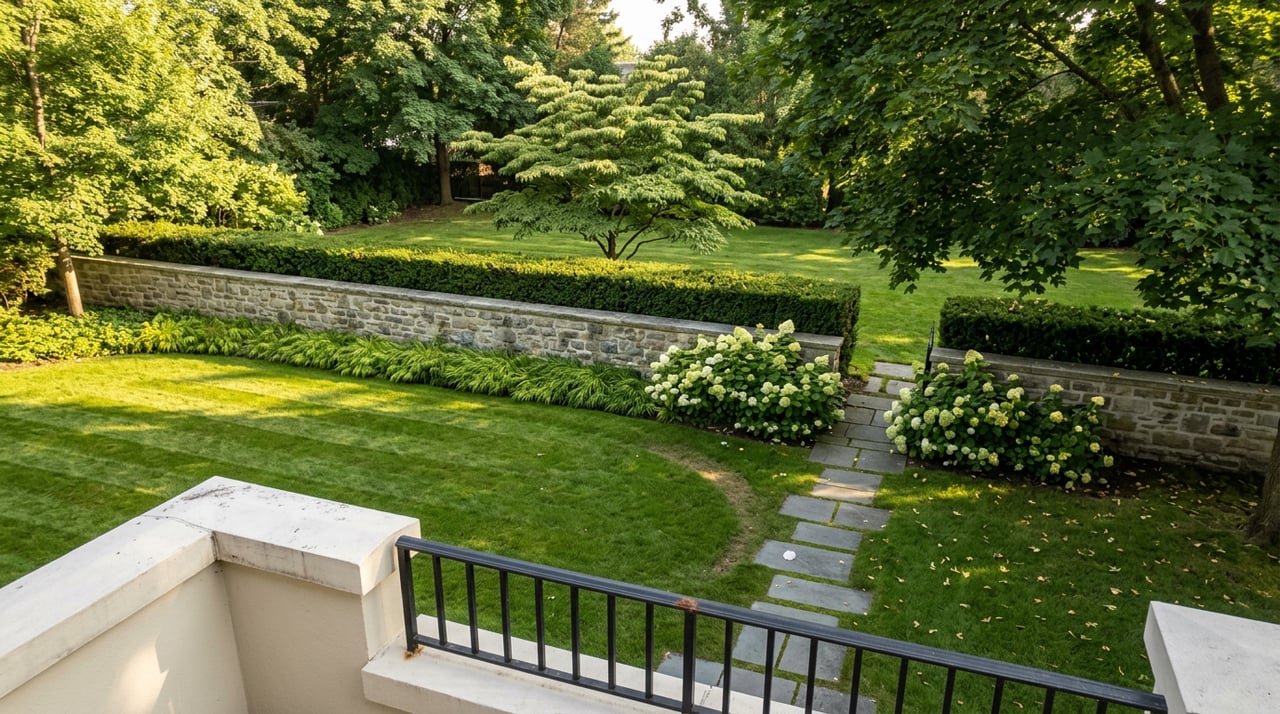
Stand in a backyard on one of the residential streets that run south to Lake Ontario near Bronte Harbour and the water can feel like it belongs to you. The lawn slopes toward a hedge, the hedge gives way to a strip of grass, and beyond that the lake stretches out past the breakwall. It looks like private shoreline. On a listing sheet, it will almost certainly say "waterfront."
Whether that lawn actually ends at the lake, or ends at a public shore road allowance or municipal park strip that the town owns, is a fact buried in the survey and the title search, not in the photos. And in Bronte and the Coronation Park corridor, that single distinction, whether the property line physically touches the water, decides what an owner can legally build, protect, and eventually sell.
Two words that are doing very different jobs
Real estate listings in this part of Oakville use "waterfront" the way a menu uses "fresh." It sounds like a guarantee, but it covers a range of very different things. The legal term that actually matters is riparian rights, and it hinges on one narrow question: does the private property boundary meet the water's high-water mark, or does something else sit between the lot and the lake?
Where the boundary does meet the water, an owner holds real riparian rights: exclusive access to the shoreline, the ability to apply for a dock, and the standing to undertake shoreline protection against erosion. Where it doesn't, because a public shore road allowance or a municipal park strip runs along the water's edge, none of that applies. The home can still carry a genuine Lake Ontario view. It just can't carry the legal control that view seems to promise.
This isn't a hypothetical confined to cottage country. Multiple property specialists covering the Oakville waterfront describe this exact pattern playing out in neighborhoods like Bronte and around Coronation Park, where public walking trails or reserved allowances separate some homes from direct shoreline ownership even though the lake is right there.
Riparian rights are also not something a deed spells out in plain language. They exist because of where the boundary sits on a survey, not because a clause says so. That is precisely why the distinction so often surfaces late in a transaction rather than early in a showing.
What a title search actually turns up
A buyer touring a home in August doesn't see a shore road allowance. A lawyer running title, or a surveyor confirming the boundary, does. By the time that happens, an offer is usually already in and conditions are running on the clock.
The practical due diligence looks like this: pull the current survey and confirm where the property line actually sits relative to the water. Check whether the parcel falls inside a Conservation Halton regulated area, since waterfront and ravine-adjacent lots often do. Ask directly whether any existing dock, retaining wall, or shoreline armor stone was permitted, or whether it was simply built and never questioned. None of that shows up in listing photos, and very little of it shows up in a standard walk-through.
The stakes are not cosmetic. A property that looks identical to its neighbor from the street, and is priced the same way, can carry a materially different long-term ceiling once the shore road allowance question is settled. That is the kind of detail that costs real money if it's missed, and it's the reason waterfront buyers in this corridor are better served by a survey and a conversation with the Town of Oakville before falling in love with a listing than after.
Even the homes with real rights answer to Conservation Halton
Owning true riparian frontage doesn't mean an owner can do whatever they want with it. Conservation Halton has administered shoreline and floodplain regulation since 1972, and the version currently in force, Ontario Regulation 41/24, requires permission for most construction or site alteration in or adjacent to regulated areas, which on this stretch of shoreline includes Lake Ontario itself as well as connected watercourses like Bronte Creek and Sixteen Mile Creek.
That covers more than new builds. Docks, retaining walls, decks, and grading changes near the water all fall under the same permitting umbrella, and Conservation Halton's own guidance recommends a pre-consultation meeting before an application is even submitted, since review timelines and the studies required depend heavily on how complete that first submission is.
For a riparian owner, this is the tradeoff for holding the rights in the first place: the shoreline is legally theirs to protect, but any structural work on it still runs through a provincial regulation, not just a municipal building permit. For a buyer evaluating two otherwise similar homes, it means the one with true riparian rights carries both more upside and more regulatory homework than the one that merely has a view.
A market that is already pricing the difference
Look at Bronte's numbers from this year and the split shows up even without sorting by shoreline status. A May 2026 report on the neighborhood put the average detached home sale price at roughly 3.725 million dollars against an average asking price near 3.999 million, meaning buyers were closing at roughly 93 cents on every asking dollar, with houses sitting on market for an average of about 41 days, a pace that ranked among the slowest for detached homes across Oakville's neighborhoods that month. Only a single detached sale closed in that reporting window, which is thin enough that it should be read as a signal of a quiet month rather than a settled trend.
Condos told a different story in the same report: values ticked up slightly rather than down, and Bronte condos were priced well above comparable stock in nearby Glen Abbey and Old Oakville, holding their position as some of the most expensive condo product in Oakville.
A separate snapshot from March 2026 put Bronte's overall median listing price, across all property types, at about 1.6 million dollars with roughly 30 days on market. That figure sits well below the average detached sale price from two months later, and the gap is the same blending problem this whole piece is about. A median that mixes condos, townhomes, and detached houses together will always undersell what a true waterfront detached home is actually trading for, the same way the word "waterfront" undersells the difference between a lot with legal shoreline rights and one with a view of somebody else's.
For a buyer comparing two listings in the same price bracket this fall, the practical read is this: detached homes in Bronte are moving slower and negotiating harder than the headline numbers suggest, and a true riparian lot in that price range has more room to hold its asking price than a comparable "waterfront view" home does, because the two are not actually competing for the same buyer.
What to check before the offer, not after
A few questions are worth asking before writing an offer on anything described as waterfront in this corridor:
- Ask for the current survey and confirm exactly where the property line meets the shoreline, not just where the lawn appears to end.
- Ask whether the parcel is inside Conservation Halton's regulated area, and if so, whether any prior owner completed a pre-consultation for existing shoreline structures.
- Ask specifically whether any dock, seawall, or retaining wall on the property was permitted, and request that documentation in writing.
- Confirm with the Town of Oakville whether a public walking trail or shore road allowance runs along any part of the frontage.
- If insurance matters to the financing, ask the carrier directly whether wave action and erosion are excluded, since Great Lakes waterfront coverage varies by insurer.
None of these questions are things a listing photo can answer, and none of them are things a seller is obligated to volunteer without being asked.
A few questions worth asking directly
Does this distinction only apply to Lake Ontario frontage, or also to Bronte Creek? Conservation Halton's regulated areas extend to connected watercourses as well as the lake itself, so a creek-adjacent lot near Bronte Creek or Sixteen Mile Creek can carry the same permitting requirements as a lakefront one, even without a lake view.
If a home doesn't have riparian rights, is there any way to get them? Sometimes a municipality will consider selling or licensing a shore road allowance to the adjacent landowner, but the process and eligibility vary by municipality and are not something to assume. Anyone considering this should raise it directly with the Town of Oakville rather than treat it as a given.
Southwest Oakville's waterfront market rewards buyers who ask the boring questions early. A survey, a Conservation Halton check, and a direct conversation with the seller's agent about what the property line actually touches will tell you more about long-term value than any listing description will. If you're weighing a purchase in Bronte or Coronation Park, or wondering what your own home's shoreline status means for its resale ceiling, Heidi Lobel can walk the property line with you before you write the offer, not after. Get your free home valuation to start that conversation.